

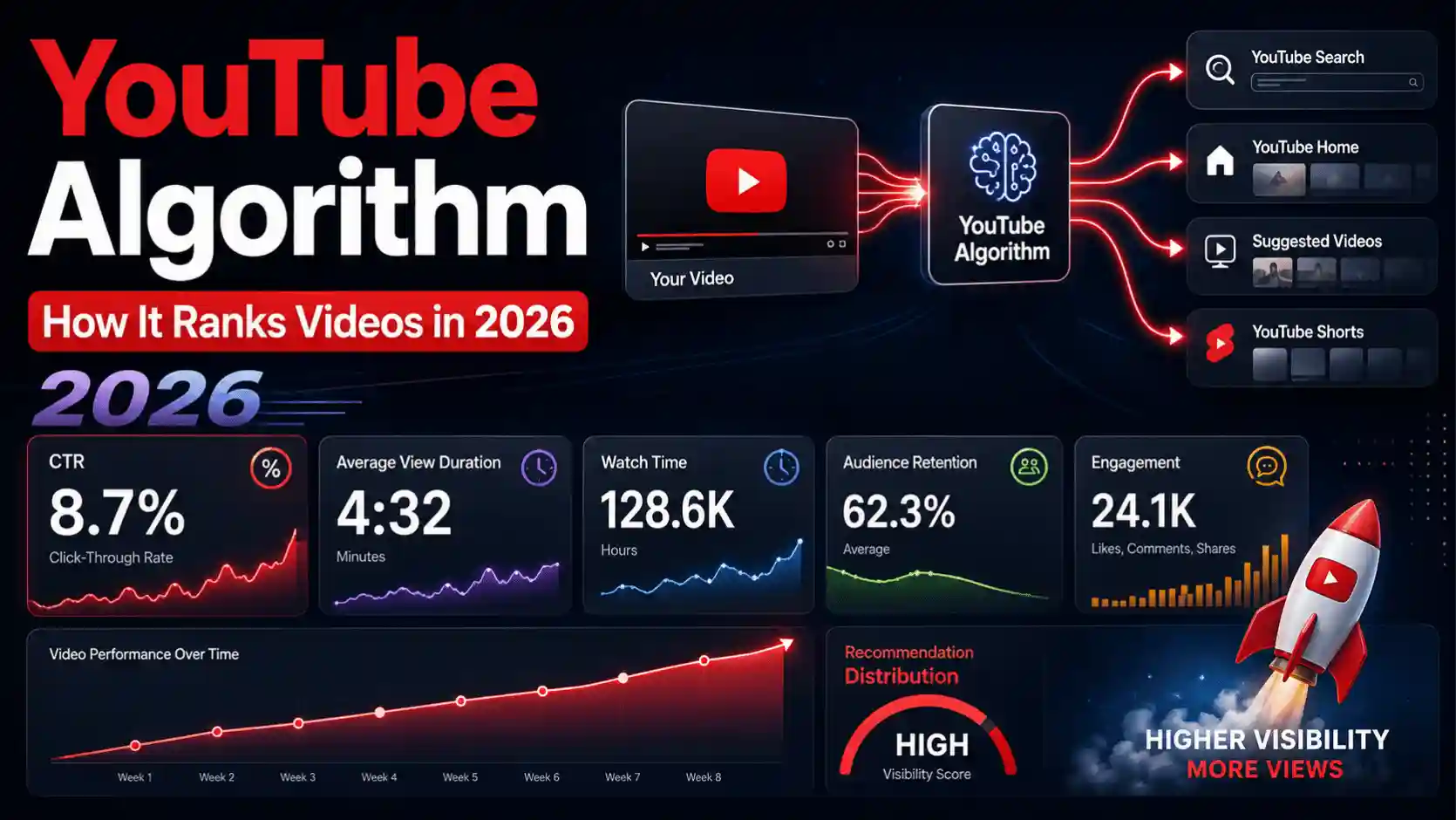
TL;DR: YouTube’s algorithm recommends your video when a small group of viewers clicks it, stays with it, and then continues watching your channel. Once your video passes that first read, YouTube shows it to a wider, colder audience and checks click-through rate and average view duration again. Win both, repeatedly, and distribution keeps growing. Lose either one, and it stops there.
Think about the last video you watched all the way to the end. You did not plan to watch it. A thumbnail caught your eye, the first fifteen seconds held you, and somewhere near the finish you clicked another video from the same channel.
That entire sequence is the algorithm.
YouTube was reading you the whole time, whether you clicked, how long you stayed, and whether you wanted more. Your own videos are being read in exactly the same way, one viewer at a time, and every number in your analytics is a record of those decisions.
Most explanations of the YouTube algorithm focus on ranking factors. For YouTube SEO, it is more useful to understand viewer behavior because it plays a major role in how YouTube recommends videos.
What is the YouTube Algorithm?
YouTube’s algorithm is a recommendation system that shows your video to a small set of viewers, watches how they respond, and expands or reduces distribution based on that response.
YouTube does not rank every video from best to worst and assign fixed positions. Instead, it tries to decide what each viewer is most likely to watch next.
The process is simple. YouTube shows your video to viewers who may be interested in the topic. Some click, while others scroll past. Those who click may stay or leave quickly. Viewers who finish may watch another video from your channel or stop watching. These actions help YouTube decide whether to show the video to more people.
If the video performs well with its initial audience, YouTube can test it with a larger audience. If viewers continue choosing it, its reach can keep growing. That is why a video can stay at 400 views for two days and then reach 50,000 views within a week. More viewers simply started watching and continued to watch it.
One important point is that YouTube evaluates videos individually. A weak video does not automatically hurt your next upload, and a viral video does not guarantee that your next video will perform well. Each video has to earn its own audience.

How YouTube Decides Who Sees Your Video
In simple terms, the YouTube algorithm promotes videos that viewers choose to click and keep watching. Click-through rate measures the first decision, while average view duration measures how long they stay.
Think of them as a pair of questions asked in order.
- Did anyone want to click? Your thumbnail and title were shown. Click-through rate records what happened.
- Did anyone want to stay? Your video started playing. Average view duration records how long it held.
A video needs both clicks and watch time to perform well. High clicks with viewers leaving quickly can signal that the title or thumbnail did not match the video. Strong watch time with very few clicks means the video is not attracting enough viewers.
YouTube also considers other viewer actions, such as continuing to watch, liking, commenting, sharing, subscribing, and survey feedback.
The key point is that these are all viewer actions. Titles, thumbnails, and descriptions matter because they influence what viewers choose to do.
Click-Through Rate: Getting the Click
YouTube Click-through rate is the percentage of people who clicked your video after seeing the thumbnail. Fifty impressions and five clicks gives you ten percent.
Most of your clicks come down to two things: your thumbnail and your title. Tags, descriptions, and upload schedules play a much smaller role. When viewers scroll through the Home page, they usually see your thumbnail and title first, and those two elements determine whether they stop and click.
What a healthy click-through rate looks like
Five to ten percent is a healthy range for most channels once a video finds its audience. Google creator documentation reports that half of all channels and videos land somewhere between two and ten percent, which tells you the top of that band is genuinely strong performance rather than a modest target.
Context changes the number, though, and reading it without context leads people to redesign thumbnails that were never the problem.
- Home page traffic: Reach goes wide, and cold viewers click less. Expect a lower percentage here and treat it as normal.
- Search traffic: People arrive with intent. Percentages run higher because they came looking for exactly this.
- Subscriber traffic: Your existing audience already trusts you, so this is usually your highest number and your least useful one.
- New channels: Early videos swing wildly. Wait for a few thousand impressions before drawing any conclusion.
How to improve click-through rate
Strong packaging makes a promise the viewer can understand instantly and believe.
Start with the thumbnail. Use one clear subject, strong contrast, and text that stays readable even at a small size. Keep the text to three or four words at most. Faces can also help because they quickly communicate emotion.
Then make the title add to the thumbnail instead of repeating it. If the thumbnail shows a burnt cake, the title should explain what viewers will learn rather than simply saying, “My cake burned.”
Two habits can make a difference. Create the thumbnail and title before recording so the video has a clear promise. Then use YouTube Studio Analytics to see how viewers respond and whether your packaging is getting the clicks you want.
Average View Duration: How Long Viewers Stay
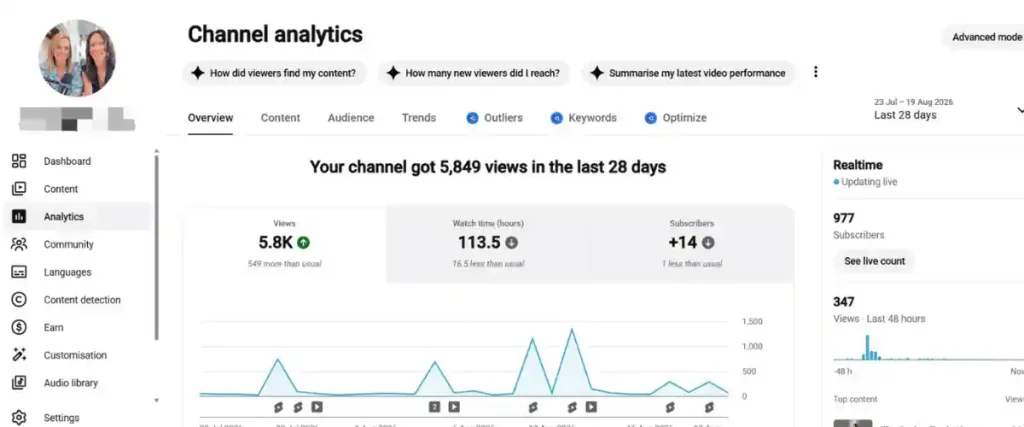
Average view duration is how long the typical viewer stays with your video. Ten minutes of content with an average of four minutes gives you forty percent retention.
Longer stays produce wider distribution. That relationship is the most consistent pattern on YouTube, and the reasoning behind it is simple: YouTube earns nothing when a viewer leaves, so it promotes the videos that keep people watching.
What actually keeps people watching
Retention is a storytelling problem far more than a production problem. Expensive cameras have never rescued a slow video.
Five things hold attention, and they hold it in this order of importance.
- Momentum: Something changes every fifteen to thirty seconds. A new location, a new argument, a new visual, a new tension. Videos die when the frame and the topic stay still together.
- A real opening: Your first fifteen seconds either confirm the promise from the thumbnail or break it. Confirm it fast and specifically, without a channel introduction in front of it.
- Story shape: Setup, complication, resolution. Even a tutorial has this shape, because a problem stated before a solution creates a reason to stay for the solution.
- Density: Cut everything the viewer already knows. Most creators lose their audience by explaining background nobody asked for.
- Payoff placement: Give value throughout instead of holding it back. A viewer who receives something at minute two will trust you enough to reach minute eight.
Retention is where storytelling stops being a creative preference and becomes a distribution decision. Pull the viewer inside the screen and the numbers follow.
How to raise average view duration
Open your audience retention graph and find the first steep drop. That single point tells you more than any general advice.
A drop in the first 20 seconds usually means the opening did not match what the thumbnail and title promised. A steady decline through the middle can point to pacing issues. A sudden drop at one point often means something specific happened, such as a long tangent or an early sponsor message.
Fix one issue in each video and compare the results with your next upload. If you change several things at once, it becomes harder to know what actually worked.
Watch Time: How It Affects Your Channel
Watch time is the total number of minutes viewers spend on your content. One person who watches three of your videos back to back for twenty minutes produces far more of it than twenty people who each leave after a minute.
Now for a distinction that most articles on this topic get wrong.
YouTube does not hold a channel-level watch time score and use it to promote your next upload. Each video is judged on its own performance. What genuinely changes is the viewer.
Somebody who watched three of your videos in one sitting has just told YouTube, in the clearest way available, that your content is worth their evening. That person now appears in your analytics as a returning viewer, and returning viewers are the strongest evidence YouTube has for showing them whatever you publish next.
So the goal is not a bigger number in a dashboard. The goal is a viewer who does not leave after one video.
Moving viewers to your next video
Four tools do this reliably, and all four are underused.
- Playlists: Group videos in a deliberate order so the next one plays automatically. Sequence them by curiosity, not by upload date.
- End screens: Point to one specific video rather than four options. Choice slows people down, and a slowed viewer closes the tab.
- Cards: Place them at the exact moment you reference another video, never at the start where they pull people away too early.
- Series structure: Build content that genuinely continues. Part two is watched because part one left something open.
Look at your traffic sources afterward. When “suggested videos” starts showing your own videos feeding each other, this is working.
Engagement Signals: Likes, Comments, and Shares
Likes, comments, and shares show YouTube that viewers found the video valuable, not just interesting.
Likes, comments, and shares are useful signals, but they do not outweigh viewer retention. A video can get strong engagement and still struggle if viewers do not keep watching. Treat engagement as a supporting signal, not a growth strategy on its own.
That said, three habits produce genuinely more of it.
- Ask an open question: Not “let me know what you think.” Ask something specific enough to have an answer, placed where the video naturally raises it.
- Reply within the first day: Early replies pull more comments, because viewers respond when someone is clearly there. After a day, the thread goes cold.
- Use the community tab: Polls, screenshots, and questions between uploads keep your channel present in the subscriber feed during the days you publish nothing.
Shares carry unusual weight. Somebody sharing your video puts their own reputation behind it, and that behavior is rare enough that YouTube treats it as a strong quality signal.
Viewer Satisfaction: The Signal That Matters
Satisfaction is YouTube asking viewers directly whether they valued the time they spent, then feeding those answers back into recommendations.
YouTube may ask viewers to rate their experience after watching a video. These survey responses are not shown directly in your usual analytics, so most creators do not see them.
Two videos can have similar retention but reach different audiences. Viewer satisfaction can be one reason for that difference. A video may keep viewers watching, but a satisfying experience can make them more likely to watch and engage with more content.
Watch time shows how long people stayed. Satisfaction shows how viewers felt about the experience.
Where the YouTube Algorithm Works Differently
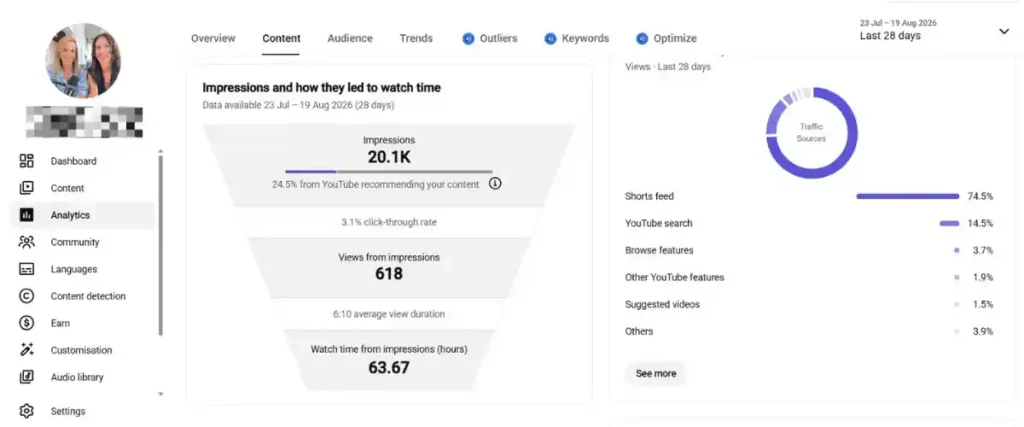
The YouTube algorithm works differently across Search, Home, Suggested Videos, and other recommendation surfaces. Each surface uses different signals to decide which videos to show viewers. A video can rank well in YouTube Search for a long time without getting the same exposure on the Home page.
Home page
Watch history drives it. Your video reaches people who have watched videos like yours, which makes topic size the real constraint on reach.
Suggested videos
Whatever is playing right now is the main signal. To appear beside a popular video in your niche, cover the natural next question rather than an unrelated subject.
YouTube search
Three things influence rankings in YouTube Search:
- Relevance: How well your title, description, and video content match the viewer’s search query.
- Engagement: How viewers respond to your video, including the watch time it generates for that search.
- Quality: Signals that show your channel provides reliable, useful information about the topic.
Search traffic can build gradually and continue for a long time, while Home page traffic can rise quickly and change faster.
Shorts feed
Shorts are judged on whether people chose to watch, stayed, and enjoyed it. For short-form video, swipe rate replaces click-through rate, and percentage viewed replaces duration. (Source – YouTube Search and Discovery)
Two facts settle recurring arguments. Shorts performance does not damage your long-form recommendations, and no minimum posting frequency exists.
| Surface | Main signal | What to work on |
| Home page | Watch history | Broad topic appeal |
| Suggested videos | Current video | Natural follow-up topics |
| YouTube search | Query match | Titles that answer real questions |
| Shorts feed | Swipe and completion | First two seconds |
| Subscriptions | Recent uploads | Publishing rhythm |
How to Analyze a Winning YouTube Channel
The fastest way to understand the algorithm is to study how successful channels approach YouTube channel optimization.
Next time you watch a video for more than ten minutes, stop and pull it apart. This exercise teaches more than any list of tips, because you are examining a real decision you actually made.
- Look at the thumbnail again – What promise did it make, and how did it make it in one image?
- Read the title beside it – Notice whether it repeats the thumbnail or completes it.
- Rewatch the first fifteen seconds – Find the exact moment you decided to stay.
- Identify what changed every thirty seconds – Location, argument, visual, tone.
- Ask what pulled you toward the next video – End screen, curiosity, an open loop, or the channel itself.
Do this with five videos from three channels in your niche and patterns appear quickly. You will notice that strong channels rarely stay on one visual setup for long, that their openings land inside a story rather than an introduction, and that every video seems to end with something unfinished.
That is the real lesson. Storytelling, flow, and momentum decide average view duration, and average view duration decides how far YouTube carries you.
Why Your YouTube Views Dropped
Views drop for four reasons, and only two of them concern your videos.
- Something changed on your side: A new topic, different editing, redesigned thumbnails, or longer videos all shift how your audience responds. Change one thing at a time so results stay readable.
- Interest in the topic fell: Demand rises and falls independently of your work. A channel covering a game that peaked two years ago declines while getting better at everything.
- Your audience shifted: Open the Audience tab. Falling regular viewers means your core audience is drifting. Falling new viewers means the content stopped attracting outsiders. You can use Best YouTube SEO Tools to analyze these changes and identify what may be affecting your traffic.
- Seasonality: Exams, holidays, and summer move viewing habits every year in patterns you can plan around.
Competition matters too. Your video competes with other videos for viewers’ attention, not just with your own older videos. Impressions can drop even when your click-through rate and retention stay strong if competing videos perform better.
What Does Not Affect the Algorithm?
Four beliefs get repeated constantly, and none of them survives contact with how the system works.
- Tags: Tags play a minimal role in discovery. They mainly help with spelling variations.
- Posting frequency: No minimum cadence exists. Publishing daily helps only when quality holds, and it usually does not.
- Paid placement: Organic positions cannot be purchased, and no amount of ad spend improves your recommendations.
- Deleting and re-uploading: Starting over discards every engagement signal the original earned and almost always performs worse.
Frequently asked questions
1. How long does YouTube take to promote a video?
No set window exists. Home page distribution usually settles inside the first three to seven days, while search traffic builds steadily over several months as a video accumulates watch time and relevance.
2. Is click-through rate or average view duration more important?
Neither one works alone. Click-through rate decides whether your video earns a chance at all, average view duration decides whether YouTube grants it a wider audience, and weakness in either number stops distribution completely.
3. Do subscribers still control your reach?
No. Subscriptions count as one signal among many, and YouTube shows subscribers your newest upload only when their recent watch history suggests genuine interest in that particular topic or format.
4. Does the algorithm punish a channel after a weak video?
No. Each video is evaluated on its own performance, so one underperforming upload does not reduce how far YouTube carries whatever you publish next. Channel history is not averaged into a permanent score.
5. Can an old channel recover after months of low views?
Yes. Open the Audience tab to identify whether new or regular viewers declined, address that specific weakness directly, then publish consistently while changing a single variable per upload so results stay readable.
What to take away
Treat YouTube distribution as feedback, not a verdict. Focus on earning the click, keeping viewers engaged, and giving them a reason to watch more. Consistent viewer satisfaction is what drives long-term growth.
Also Read: What Is YouTube SEO? 7 Steps to Optimize Your Video in 2026