


Short-form video has become a huge part of how people consume content today. One viral video can put an unknown creator in front of millions of people almost overnight.
The catch is that the opening three seconds decide it, because the viewer’s thumb is already moving before your first sentence lands. YouTube Shorts alone averages around 200 billion views a day, according to Neal Mohan’s 2026 letter on the YouTube Blog, and almost none of those views come from people who went looking for a particular video.
That scale is why the format works, and why most businesses still get nothing out of it. This guide explains what counts as short-form now that the length rules have collapsed. It also covers how the YouTube algorithm decides who sees your video and what the biggest channel on YouTube actually did to grow. Finally, it shows how to use short-form video for a business rather than simply chasing fame.
What is Short-Form Video?
Short-form video refers to brief, usually vertical videos designed to capture attention quickly and deliver entertainment, information, or value in a short amount of time. They typically last under 60 seconds, although platforms such as YouTube and Instagram now allow videos up to 3 minutes.
The format is defined by how the platform distributes it, not by how long it runs. Shorts, Reels, and TikToks all behave the same way: the platform tests a video on a small group of viewers, reads what those viewers do, then expands or quietly stops it.
That mechanism separates the format from a normal upload. Regular YouTube videos reach people who already subscribed or searched for the topic. Shorts reach people who did neither, which changes what the first frame has to accomplish.
Why the “under 60 seconds” definition no longer holds
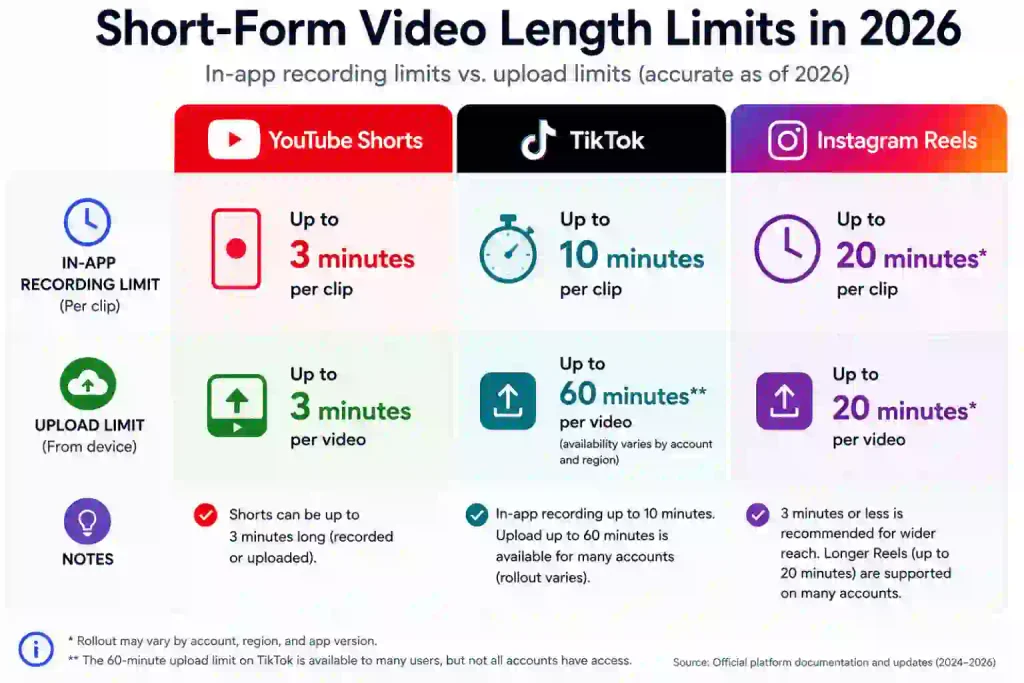
The 60-second rule stopped being accurate once every major platform raised its limits. YouTube Shorts now run up to three minutes, according to YouTube’s Shorts documentation. TikTok records up to 10 minutes inside the app and accepts uploads of up to 60 minutes, per TikTok Support. Instagram records up to 20 minutes on its Reels surface.
Hold on to the old definition, and a 45-minute TikTok upload still qualifies, which is obviously wrong. Duration was always standing in for something else. The platforms have now outgrown it, and they say so in their own documentation.
What actually makes a video short-form
Three traits make a video short-form, and length is not one of them.
Full-screen and vertical: the video occupies the entire phone screen, so nothing on the page competes with it for attention.
Algorithmic distribution: reach is decided per video by how viewers respond, not by how many followers the account already has.
No required context: the video has to make sense to somebody who has never heard of your brand, because that is exactly who receives it.
Instagram draws the boundary in the same place. Its Reels product page states that Reels longer than three minutes will not be recommended to new audiences, which means Instagram treats the format as a distribution category with a length ceiling attached, rather than as a length category.
How long is a Short-Form Video?
Most short-form video runs between 15 and 60 seconds, even though every platform now permits far more. Two different numbers are at play, and marketers routinely confuse them: the length a platform accepts, and the length a platform still promotes to strangers.
Length limits on each platform
| Platform | Records in app up to | Accepts uploads up to | Still pushed to new viewers |
| YouTube Shorts | 3 minutes | 3 minutes | Full 3 minutes |
| TikTok | 10 minutes | 60 minutes | No published ceiling |
| Instagram Reels | 20 minutes | 20 minutes | Under 3 minutes |
Instagram is the row worth studying. Its Help Center still lists three minutes as the recording limit, while its product page lists 20, so take the number both sources support: three minutes is where the recommendation to new audiences stops. Publishing a six-minute Reel is allowed. Expecting the algorithm to hand it to strangers is not.
How long your videos should actually be
Run the video as long as the payoff needs and stop there. A 20-second clip answering one question beats a 90-second clip answering the same question with padding, because completion and replays are the strongest signals the feed reads, and padding costs you both.
One idea per video is the rule that keeps short-form content focused. If you have three tips, make three videos instead of packing them into one. Cut on the payoff, not after it, and skip the closing sign-off that gives viewers an obvious reason to leave. Keep your YouTube video description just as focused.
Why Short-Form Video Reaches People Your Other Content Doesn’t
Short-form video reaches strangers because the platform decides distribution, not your follower list. Every upload starts from roughly the same position: a small test audience assembled from interest signals, then expansion or shutdown based on measured response. Blogs, newsletters, and standard YouTube uploads all depend on an audience you already built. Feeds do not, which is one reason YouTube SEO works differently for short-form content.
Distribution doesn’t depend on your follower count
New accounts and large accounts enter the same test. Follower count shapes the starting sample and gives established creators a warmer first audience, but it will not carry a weak video, and its absence does not sink a strong one. That asymmetry is the whole opportunity for a business with no audience yet.
Long-form YouTube works the other way around. Subscribers see the video first, their response decides whether anyone else ever does, and building from zero there is slow. Feeds remove that dependency, making How to Grow a YouTube Channel Fast a more achievable goal when you use short-form content strategically.
The opening seconds decide whether the video survives
The first two seconds determine whether the rest of the video ever gets measured. Viewers in a feed are not choosing your video; they are deciding whether to escape it, and a swipe inside two seconds tells the platform the video failed before the content was judged at all.
Front-load accordingly. State the result, the question, or the surprise immediately, then earn the rest. Introductions, logo stings, and “in this video I’ll show you” openings all spend your only unrecoverable asset on nothing.
Where Shorts appear outside the feed
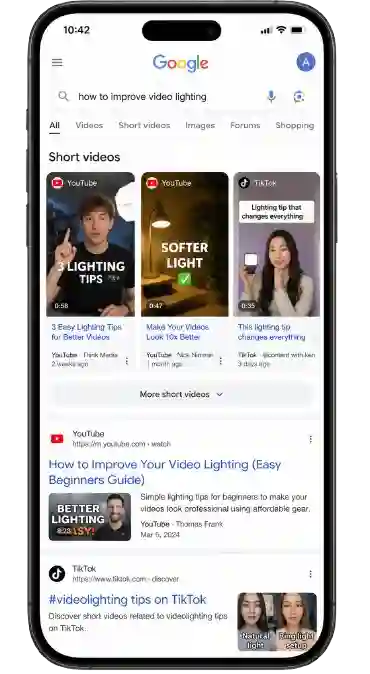
Shorts surface well beyond the Shorts feed, including YouTube search results, your channel page, and recommendations, as documented in YouTube’s Shorts guidance. Vertical video also appears in Google’s mobile results as a short video carousel, so a well-titled Short can answer a search query months after publication.
Test that yourself in a minute. Type a question your customers ask into Google on your phone, scroll to the short video results, and look at who is answering it. YouTube Studio Analytics can then show you whether those search appearances are turning into views and engagement. Whatever ranks there is your real competition for that question, and it is usually a creator rather than a company.
Short-Form Video Platforms Compared
The three major platforms differ less in what they allow and more in what happens to a video after its first 48 hours.
| Platform | In-app limit | Upload limit | How discovery works | Findable weeks later |
| YouTube Shorts | 3 minutes | 3 minutes | Shorts feed, YouTube search, Google results | Yes, search keeps working |
| TikTok | 10 minutes | 60 minutes | For You feed, in-app search | Partly, search-dependent |
| Instagram Reels | 20 minutes | 20 minutes | Reels feed, Explore | Rarely, feed-dependent |
Search behavior should drive the decision. YouTube Shorts inherits YouTube’s search surface and Google’s, so a Short answering a specific question keeps earning views long after the feed moves on. Reels behaves more like a broadcast: strong initial reach, limited afterlife.
How to choose the right short-form video platform for your business
Choose based on where your buyers already search and how long each video needs to keep working. Three criteria settle it for most businesses.
Search intent in your category: if customers type questions before they buy, YouTube Shorts compounds because those videos remain discoverable.
Where your audience already scrolls: a B2B audience that lives on LinkedIn and YouTube is not waiting for you on TikTok, whatever the growth numbers say.
Production capacity: one platform done properly beats three done at a third of the quality, because every feed judges each video against the best content available to it.
For most small and mid-sized businesses, start with YouTube Shorts, then repurpose to Reels and TikTok once a repeatable format exists. Shorts gives you the searchable afterlife, and the same vertical file works on both others without re-editing.
What the Biggest Channel on YouTube Reveals About Short-Form Video
MrBeast’s story is the example everyone reaches for when arguing that vertical video drives growth, and the full story is more useful than the version usually told.
How MrBeast built the audience in the first place
Jimmy Donaldson, who publishes as MrBeast, became the first YouTube channel of any kind to pass 500 million subscribers on June 12, 2026, according to the YouTube Blog. The milestone is recent. Donaldson’s method is not, and he has been a recognizable face on the platform for close to a decade.
Three decisions built that channel:
- Volume
- Study
- Deliberate content shift
Volume: Years of consistent uploads helped him learn what worked. Each video was treated as a test rather than simply another publication.
Study: Donaldson closely studied YouTube metrics such as click-through rate and audience retention. He used that data to understand what the platform rewarded and changed his videos accordingly.
Deliberate content shift: He moved away from commentary toward extreme stunts and large cash giveaways. This created a simple content formula where the thumbnail, title, and opening all clearly communicate what viewers can expect. For creators focused on long-form growth, understanding this difference also matters when working toward how to get 4,000 watch hours on YouTube.
That third decision is what made the content portable into short-form. A giveaway or a stunt needs no setup, no backstory, and no trust in the presenter, which is precisely the condition a feed imposes.
What made his short-form videos work
Four things carry MrBeast’s Shorts, and three of them cost nothing to copy.
Emotional hooks in the first frame: a countdown, a prize, or a person about to win or lose something, stated before the viewer has decided whether to stay.
Rapid-fire pacing borrowed from the main channel: cuts land every second or two, which reads as urgency in an environment built for scrolling.
Cross-promotion from an enormous existing audience: a main channel at that scale means every Short opens with viewers who signal interest immediately, which is exactly what the early test measures.
Production legible at thumbnail size: stadium-scale setups, physical builds visible in a single frame, and recognized online personalities appearing as guests, all of which explain the video before a word is spoken.
Only the third one requires scale. Hooks, pacing, and a visually legible first frame are format decisions, and a two-person business can make all three tomorrow.
The Other Side of the MrBeast Story
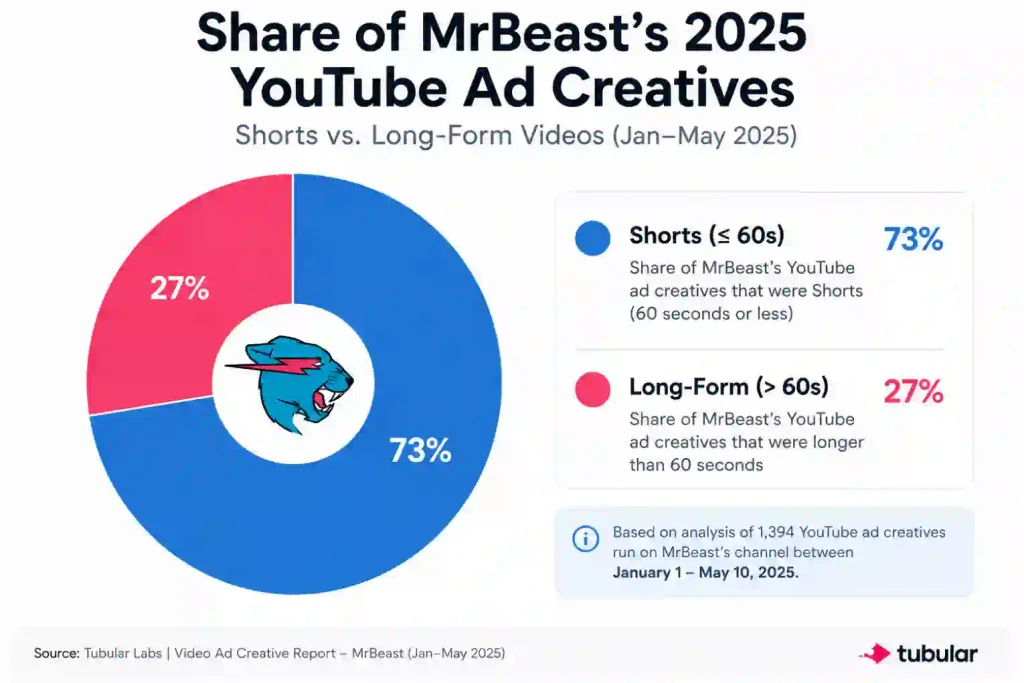
A large share of that growth was paid, not organic. Net Influencer’s analysis of MrBeast’s 2025 YouTube ad campaigns found that of 98 unique ad creatives, 90 were Shorts. One 17-second Short offering an iPhone giveaway ran as a paid ad for roughly nine months across India, Indonesia, Vietnam, Turkey, and Thailand, localized into languages including Hindi, Telugu, Tamil, Punjabi, and Marathi. When those campaigns paused in April, daily subscriber growth reportedly fell from around 220,000 a day to around 120,000, then recovered once the ads resumed.
Read the mechanism rather than the headline. The most cited proof that short-form video produces explosive organic growth is substantially a media buying story: vertical video used as ad creative, in low cost-per-view markets, at a spend level nobody reading this will match. Competing articles present the same curve as organic evidence, which is how a paid distribution result becomes everyone’s content strategy.
Why “Shorts feed your long-form” is only half true
Short videos do not reliably move viewers into long videos, and the person running the largest channel on YouTube has said so publicly. MrBeast’s YouTube strategist stated on HubSpot’s Marketing Against the Grain podcast that Shorts are not really good at driving people to long-form, and that engagement on a Short does not mean the same viewer will sit through a 15-minute video.
The mechanism explains the gap. Viewers arrive in a feed with the next video one thumb movement away, so the default action after any Short ends is to keep scrolling rather than change surfaces and commit ten minutes. Watching a 30-second clip signals tolerance for 30 seconds and nothing more.
That is why effective YouTube Channel Optimization gives each format its own job instead of treating Shorts as a guaranteed funnel into long-form content. Shorts can build awareness, demonstrate expertise, and answer one focused question completely, while long-form videos can develop deeper interest, trust, and watch time. Build your strategy around what each format naturally does well rather than expecting one format to automatically feed the other.
What transfers to a business with no budget
Four practices transfer, and none depend on spend. Front-load the hook before anything else. Build every clip around a single idea a stranger can grasp cold. Make the first frame explain itself visually, since most viewers meet you with the sound off. Treat each video as a standalone ad rather than a trailer, because the feed judges it that way regardless of your intent.
What does not transfer is the growth rate. Comparing your Shorts performance against a channel running a nine-month international ad campaign is comparing your organic reach against somebody’s media budget.
How to Make Short-Form Video Work for Your Business
Short-form video marketing works for a business when each video answers one real customer question well enough to stand alone. Reach follows usefulness on this surface more reliably than anywhere else, because the feed serves your video to people with no prior relationship to your brand.
Start with one question your customers actually ask
Pull your topics from questions you already answer on sales calls, in support tickets, and in your inbox. Those questions are pre-validated demand, because somebody cared enough to ask a human being.
Write 20 of them down before filming anything. A pricing objection, a “can you do X” question, and a common industry mistake are each worth a video, and the list keeps your short-form video content anchored to buyers rather than trends.
Structure: Hook, Payoff, Loop
Use three parts and no more. Hooks state the question or the result inside the first two seconds. The payoff delivers the answer in the middle, without preamble or credentials. Closing on a loop sends the viewer back to the opening frame rather than out of the video, which is why the ending should never announce itself.
Worked example for a dental clinic: open on “Whitening strips are why your teeth hurt,” answer with the specific reason and what to do instead, then close on the sentence that makes the opening claim make sense. Around 25 seconds, one idea, no introduction.
Write for sound-off viewing
Assume every viewer has muted the video and write for the screen. Burn captions in rather than relying on auto-captions, put the key claim as on-screen text in the first frame, and make sure the visual alone carries the topic if the words never load.
Test the result by muting your own video and watching it back. Anything you cannot follow, a stranger cannot follow either.
Publish so the video stays findable
Title and describe the video the way somebody would search for it. A Short titled with the actual question keeps earning views through YouTube search and Google’s mobile results long after the feed stops serving it, which is the difference between short-form video content that works for a week and content that works for a year.
YouTube also gives you a check most marketers never use. The Get feedback option on the Shorts upload screen analyzes hook strength and pacing before you publish, and running two hook versions through it teaches you more than waiting on the results.
How to Measure Short-Form Video Performance
Judge performance on engaged views, retention, and replays, not on the view count shown on the video. The headline number changed meaning in 2025, and most reporting has not caught up.
Views and engaged views are not the same number
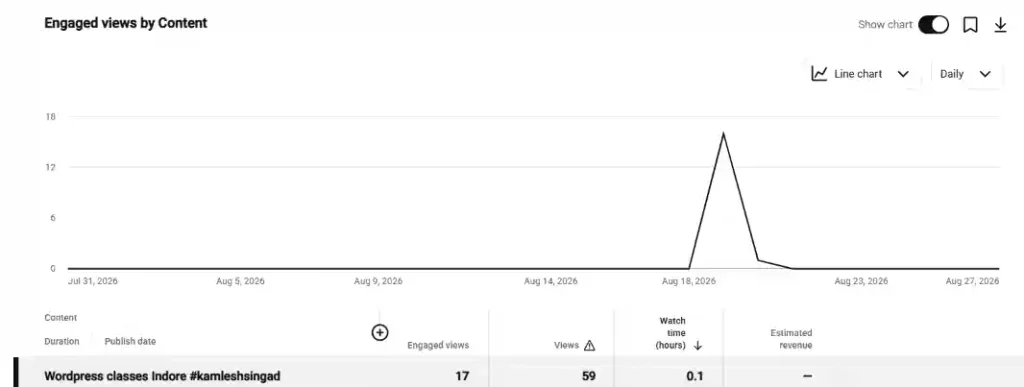
Since March 31, 2025, YouTube counts a Shorts view the moment the video starts to play or replay, with no minimum watch time required, as documented in YouTube’s Shorts guidance. The older, stricter definition survives under a new name, engaged views, and engaged views is what still governs Partner Program eligibility and revenue share, per YouTube’s Shorts monetization policies.
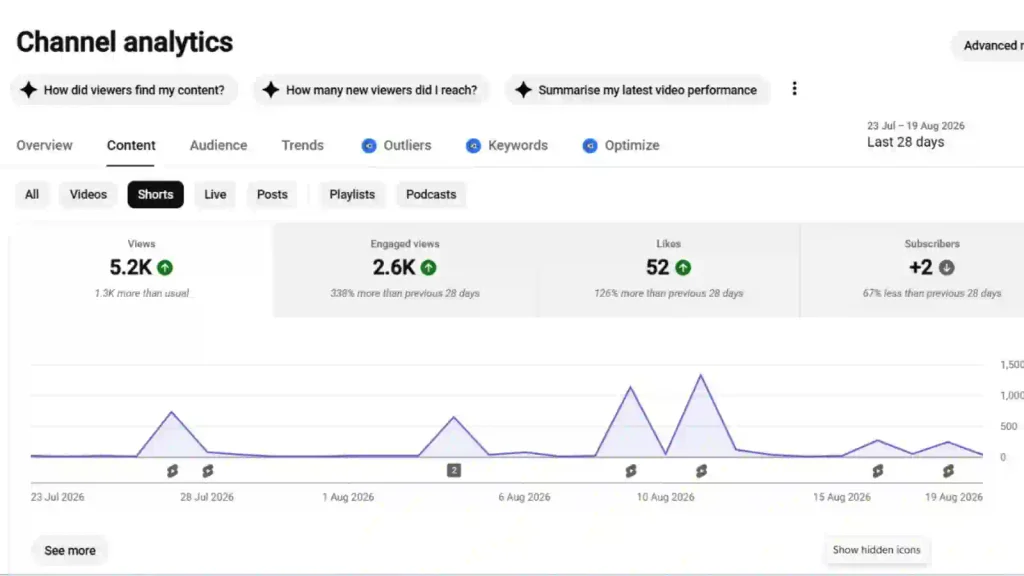
Look at both on your own channel. Open YouTube Studio, switch Analytics to Advanced Mode, and compare Views against Engaged views for a single Short. That gap is the difference between how many phones the video appeared on and how many people watched it.
The signals that actually predict distribution
Retention in the first three seconds predicts distribution better than any other number you can see. Watch three figures in order: the percentage still watching at three seconds, average percentage viewed, and replays, which show the loop worked. Shares matter more than likes, because a share puts the video in front of an audience the platform did not select.
Why your pre-2025 numbers don’t compare
Any Shorts comparison spanning March 2025 measures two different definitions and calls the difference growth. A channel that looks like it tripled may have identical engaged views on both sides of that date, because the counting method changed underneath the metric.
Rebase your reporting instead of explaining the jump. Set the baseline after April 2025, report engaged views alongside views in every deck, and treat any published growth statistic that straddles the change as unusable.
Frequently asked questions
1. What is short-form video?
Short-form video refers to brief, usually vertical videos designed to capture attention quickly and deliver entertainment, information, or value in a short amount of time.
2. How long should a short-form video be?
Most effective clips run 15 to 60 seconds. Platforms allow far longer, but Instagram stops recommending Reels over three minutes to new audiences, so shorter videos reach more strangers.
3. Is short-form video better than long-form video?
Neither wins outright. Short clips reach new audiences who never searched for you, while long-form builds depth and trust with viewers who already chose your channel.
4. Which platform should a small business start with?
YouTube Shorts, in most cases. Shorts appear in YouTube search and Google mobile results, so a well-titled video keeps earning views months after the feed stops promoting it.
5. How often should you post short-form videos?
Three to five videos weekly is a realistic starting point. Consistency matters less than hook quality, since each video is judged independently rather than rewarded for your posting schedule.
Conclusion
Distribution decides everything in short-form video, which is why length arguments and posting-frequency debates miss the point. Platforms hand each video to strangers and score what those strangers do in the first three seconds, so the hook, the single idea, and the sound-off first frame are where your effort belongs.
Start with the questions your customers already ask, publish to YouTube Shorts so the videos stay searchable, and measure engaged views rather than the number on the thumbnail. Judge the experiment after 30 videos, not three, and compare against your own baseline rather than a channel buying its distribution.
Also Read: What is YouTube SEO? 7 Steps to Optimize Your Video in 2026