



You’ve probably already invested in content, keywords, and backlinks to improve your search rankings. But if search engines can’t crawl, render, or index your pages properly, none of that investment reaches its full value. In this guide, you’ll learn what technical SEO services include, how audits work, and how they create the foundation for sustainable organic growth.
Key Takeaways
- Technical SEO services optimize a website’s infrastructure so search engines can crawl, render, index, and rank pages efficiently.
- Crawlability, indexability, Core Web Vitals, structured data, and site architecture form the foundation of every successful technical SEO program.
- Hidden technical issues can suppress rankings even when content quality and backlink profiles are strong.
- Regular audits prevent indexing errors, duplicate content, broken links, and performance regressions from accumulating.
- Modern technical SEO supports both traditional Google rankings and visibility in AI-powered search experiences.
- Long-term organic growth requires combining technical SEO with high-quality content and authority building.
- An experienced provider ensures fixes are prioritized by impact, implemented correctly, and measured over time.
What Are Technical SEO Services?
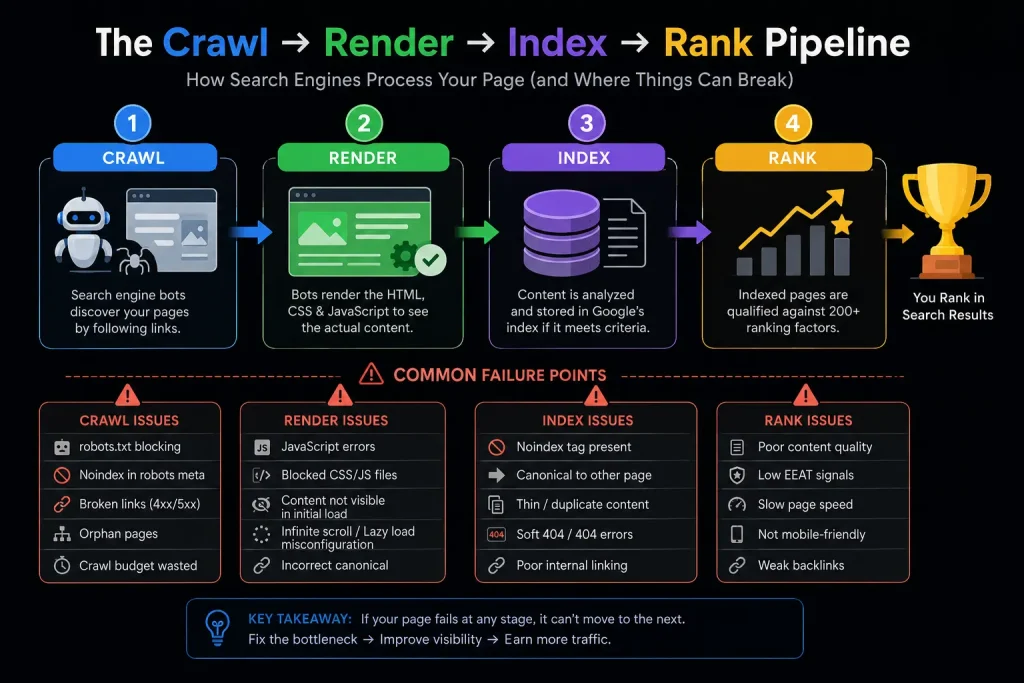
Technical SEO services are the process of optimizing a website’s technical infrastructure so search engines can efficiently crawl, render, index, and rank its pages. These services sit beneath your content layer and cover everything from server response times and URL structure to schema markup and JavaScript rendering.
First, it helps to picture how search works. A search engine discovers URLs, fetches them, renders the page, decides whether to index it, and only then considers it for ranking. If any step in that chain breaks, your page never competes — regardless of how good the writing is.
For example, a product page blocked by a stray Disallow rule in robots.txt will never appear in results, even if it targets a keyword with 10,000 monthly searches. That’s a technical problem, not a content problem.
Most engagements are delivered by a technical SEO agency or an independent technical SEO consultant, either as a one-off website technical audit or as an ongoing retainer with implementation support.
Why Are Technical SEO Services Important for Search Rankings?
Technical SEO creates the foundation that allows content, backlinks, and on-page optimization to achieve their full ranking potential. Without it, you’re compounding effort on top of a broken base.
The scale of the problem is measurable. Only 48% of mobile origins and 56% of desktop origins passed all three Core Web Vitals in 2025 — Source: HTTP Archive Web Almanac, 2025. More than half the mobile web is failing a bar that Google publishes openly.
Moreover, the stakes have shifted. Roughly 68% of US Google searches now end without a click, and AI Overviews appear on more than 20% of searches — Source: SparkToro via Search Engine Land, 2026. When fewer clicks are available, being crawlable, fast, and structured is what determines whether you’re the source that gets cited.
Plus, technical health compounds. A site that fixes its crawl paths, response times, and duplicate URLs sees every future piece of content indexed faster and ranked more predictably. If you’re competing in a defined market, this is also the groundwork for effective SEO services in Indore or any other local market you’re targeting.
What Is the Difference Between Technical SEO and On-Page SEO?
Technical SEO governs how search engines access a website, while on-page SEO governs how they interpret an individual page’s content. Off-page SEO, by contrast, covers the external signals — mostly links and mentions — that establish authority.
For example, fixing a redirect chain is technical SEO. Rewriting that page’s title tag and headings is on-page SEO optimization. Earning a link to it from an industry publication is off-page SEO.
| Dimension | Technical SEO | On-Page SEO | Off-Page SEO |
| Core question | Can search engines access and understand the site? | Is this page relevant to the query? | Is this site trustworthy? |
| Typical work | Crawl budget, indexing, speed, schema, redirects | Titles, headings, content depth, internal anchors | Link acquisition, digital PR, brand mentions |
| Owned by | Developers + SEO specialists | Content and SEO teams | Outreach and PR teams |
| Time to impact | Days to weeks after deployment | Weeks | Months |
| Fails look like | Pages missing from the index | Pages indexed but irrelevant | Pages relevant but outranked |
As such, the three disciplines are sequential rather than competitive. Technical work removes the ceiling; content and authority raise the floor.
What Is Included in a Technical SEO Service Package?
A professional technical SEO service package includes crawlability, indexability, site architecture, performance, structured data, and security work, delivered as an audit followed by prioritized implementation. Let’s take a look at the components that matter most.
Crawlability and Indexability
Crawlability determines whether search engines can reach your URLs, while indexability determines whether they’re allowed to store them. Both are controlled by robots.txt, meta robots tags, canonical tags, and internal link paths.
For example, Google’s own guidance says crawl budget management is primarily relevant for sites with 1 million+ unique pages updated weekly, or 10,000+ pages updated daily — Source: Google Search Central, 2026. Below those thresholds, the usual culprit isn’t budget — it’s a misconfigured directive. Need to fix your XML sitemaps and clean up indexing issues? Partner with our expert SEO agency in Indore to build a flawless technical SEO foundation.
Site Architecture and Internal Linking
Site architecture defines how pages are grouped and linked, which directly shapes what search engines consider important. A flat, logical structure means your money pages sit within three clicks of the homepage.
By auditing orphan pages and click depth, you can surface content that’s technically indexed but effectively invisible.
Core Web Vitals and Website Speed
Core Web Vitals measure loading performance, visual stability, and interactivity, making them important signals for both user experience and search performance. Google’s published thresholds are LCP under 2.5 seconds, INP under 200 milliseconds, and CLS below 0.1 — Source: Google Search Central, 2025.
In practice, loading is where most sites lose. Only 62% of mobile pages achieve a good LCP, compared with 77% for INP and 81% for CLS — Source: HTTP Archive Web Almanac, 2025. For the metric-by-metric breakdown, see our Core Web Vitals guide and our website speed optimization walkthrough.
Structured Data and Schema Markup
Structured data helps search engines understand page content and can improve eligibility for rich results and AI-generated search summaries. It’s added as JSON-LD and validated with Google’s Rich Results Test.
For example, an Article schema block with a named author, publish date, and organization can make a page far easier for an AI system to attribute correctly.
Redirects, Broken Links, and Migrations
Redirect handling controls whether accumulated authority survives a URL change. Chains, loops, and 404s leak equity and waste crawl requests on every visit.
For example, a redesign that maps 800 old URLs to a single homepage — instead of to their closest equivalents — routinely erases years of rankings. Follow an SEO migration checklist before any replatform, not after.
How Does a Technical SEO Audit Improve Website Performance?
A technical SEO audit analyzes crawlability, indexability, website performance, structured data, site architecture, and other backend factors that influence organic visibility. It converts a vague sense that “rankings are down” into a ranked list of specific, fixable defects.
Here’s the sequence most agencies follow:
- Crawl the site with Screaming Frog or Sitebulb to map every URL, status code, and redirect.
- Cross-reference Search Console to compare what you published against what Google actually indexed.
- Pull field performance data from CrUX or PageSpeed Insights rather than relying on lab scores alone.
- Analyze server log files to see which URLs Googlebot actually requests, and how often.
- Validate structured data and check rendering with the URL Inspection tool.
- Prioritize by impact and effort, then hand developers a ticket-ready specification.
That being said, an audit that ends at a PDF is worth very little. The value sits in step six — turning diagnostic findings into prioritized, live code fixes that actually get deployed.
What Are the Most Common Technical SEO Issues?
The most common technical SEO issues are indexing gaps, slow loading, duplicate URLs, broken internal links, and unrendered JavaScript content. Each one is invisible in a content report and obvious in a crawl.
- Unsized images causing layout shift. 62% of mobile pages fail to set explicit dimensions on at least one image — Source: HTTP Archive Web Almanac, 2025.
- JavaScript-rendered content that Googlebot never sees because it depends on a client-side fetch.
- Duplicate URL variants from parameters, session IDs, and faceted navigation without canonical tags.
- “Discovered — currently not indexed” clusters in Search Console, usually signalling thin or low-priority pages.
- Heavy main-thread work. Median mobile Total Blocking Time rose 58% year over year to 1,916 milliseconds — Source: HTTP Archive Web Almanac, 2025.
Which Tools Are Used for Technical SEO Audits?
Professional technical SEO audits rely on a crawler, Google’s own diagnostics, and a log file analyzer. No single tool covers the full picture, which is why credible providers combine free and paid options.
| Tool | Best for | Cost |
| Google Search Console | Index coverage, Core Web Vitals field data, URL inspection | Free |
| PageSpeed Insights / CrUX | Real-user performance data | Free |
| Screaming Frog | Full-site crawls, status codes, redirect mapping | Free up to 500 URLs |
| Sitebulb | Visual architecture and crawl-depth reporting | Paid |
| Ahrefs / Semrush Site Audit | Scheduled health monitoring, issue trending | Paid |
| Oncrawl | Log file analysis and crawl budget at enterprise scale | Paid |

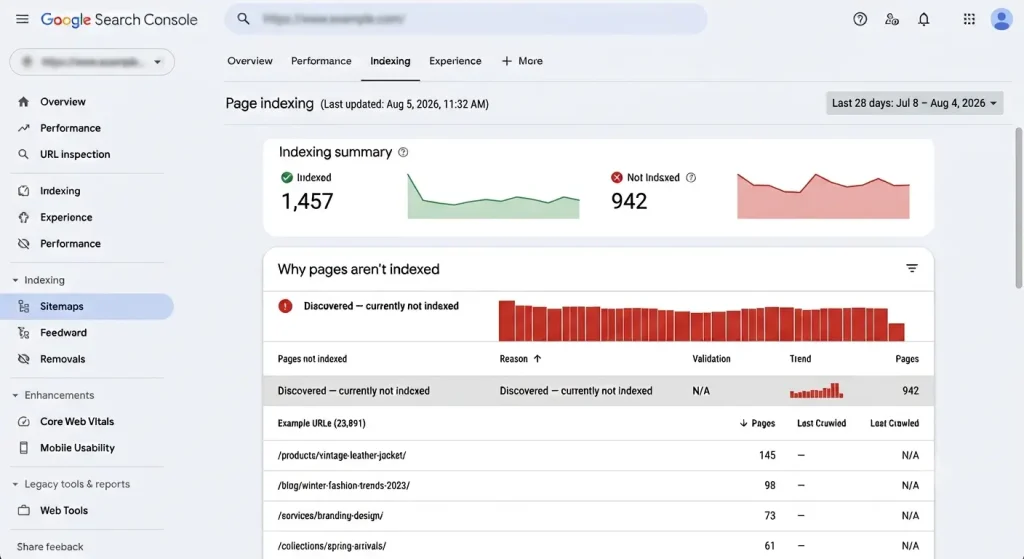

Start with the free stack. Search Console and PageSpeed Insights will surface most issues on a site under 500 pages before you spend anything.
What Should You Do After a Technical SEO Audit?
After an audit, fix issues in order of ranking impact, verify each change in Search Console, and re-crawl to confirm nothing regressed. Sequence matters more than volume.
First, resolve anything that blocks indexing — robots directives, noindex tags, and canonical conflicts. Second, fix redirect chains and broken internal links. Third, address Core Web Vitals, starting with LCP. Finally, layer on structured data and architecture improvements.
Then measure. Track indexed page counts, crawl frequency from log files, Core Web Vitals pass rates, and impressions by page group — not just rankings. Once the foundation is stable, redirect your budget toward an SEO content strategy that can now actually rank.
How Do You Choose the Right Technical SEO Agency?
Choose a technical SEO provider that shows you its audit methodology, prioritizes fixes by business impact, and offers implementation support rather than recommendations alone. Ask for a sample deliverable before you sign anything.
Four questions worth asking:
- Will you analyze server log files, or only crawl data?
- Who implements the fixes — your team, mine, or a shared backlog?
- How will we measure success in the first 90 days?
- What happens if a fix requires a developer sprint we can’t schedule?
When e-commerce store Laxmipillows completed a site transition, their organic traffic dropped sharply. The move left behind widespread 404 errors and broken internal links, forcing Google to waste crawl budget on dead URLs instead of ranking active product pages.
We audited their entire site architecture, cleaned up URL parameters, and built precise 301 redirects to save link equity. Within 30 days, Google re-indexed the right pages, organic traffic fully recovered, and daily sales got back on track.
Conclusion
Technical SEO services aren’t a one-time cleanup — they’re the maintenance layer that keeps everything else working. Start with a free crawl and a Search Console review this week, fix what blocks indexing first, and only then scale your content investment.
If your traffic has plateaued despite consistent publishing, the bottleneck is probably beneath the content. Book an audit and find out.
Frequently Asked Questions (FAQ)
1. How much do technical SEO services cost?
Technical SEO services are usually priced as a one-off audit or a monthly retainer. Cost scales with site size, CMS complexity, developer involvement, and whether the provider implements fixes or only recommends them.
2. How often should a website undergo a technical SEO audit?
Most sites need a full technical audit annually, with lighter quarterly health checks. Run one immediately before any redesign, replatform, or migration, since those events cause the largest indexing losses.
3. How long does technical SEO take to show results?
Indexing fixes can show within days once Google recrawls affected URLs. Speed and architecture improvements typically take four to twelve weeks to appear in rankings and Search Console field data.
4. Can I do technical SEO myself, or do I need an agency?
Small sites can handle basics using free tools like Search Console and Screaming Frog. Technical SEO services become worthwhile once log file analysis, JavaScript rendering, or enterprise-scale crawl issues are involved.
5. Do technical SEO services help with AI search visibility?
Yes. AI engines crawl and parse pages the same way search engines do, so clean indexing, fast rendering, and valid structured data directly affect whether your pages get cited.