


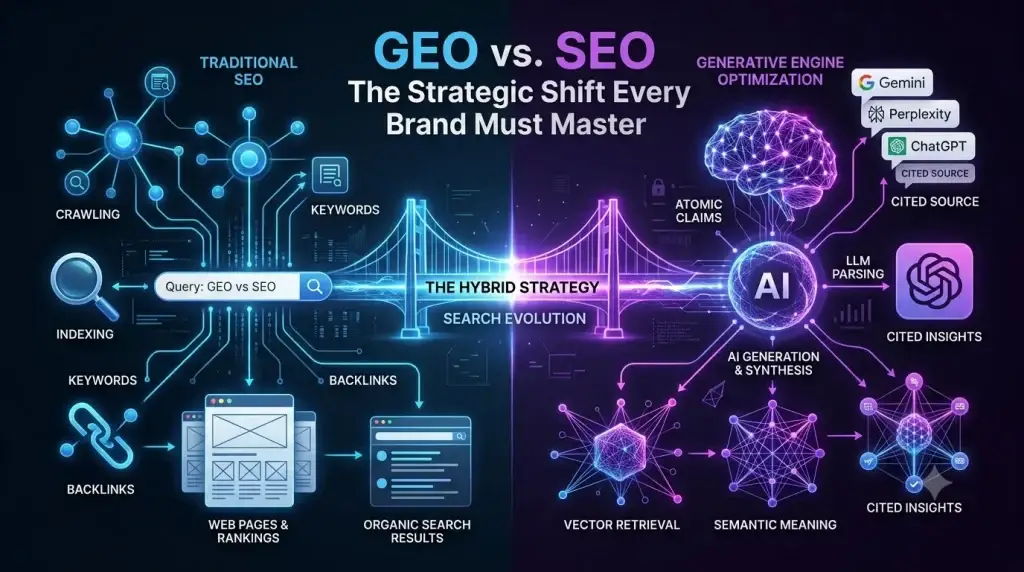
GEO vs SEO is no longer a theoretical debate. It is the difference between being found in traditional search results and being cited inside AI-generated answers.
People still use Google, but they increasingly rely on ChatGPT, Gemini, Perplexity, Claude, and Google’s AI Overviews to get direct answers.
If your brand is optimized only for search rankings, you’re missing a growing share of AI-driven visibility. The future belongs to businesses that optimize for both humans and intelligent systems.
What You’ll Learn
- The difference between SEO and GEO
- How AI search engines retrieve information
- Why rankings alone are no longer enough
- How LLMs decide which websites to cite
- A practical framework for combining SEO and GEO
- The metrics that actually matter in AI search
GEO vs SEO: What Is the Difference?
What is Search Engine Optimization (SEO)?
Search Engine Optimization (SEO) is the process of improving a website so search engines can crawl, understand, index, and rank its pages for relevant queries.

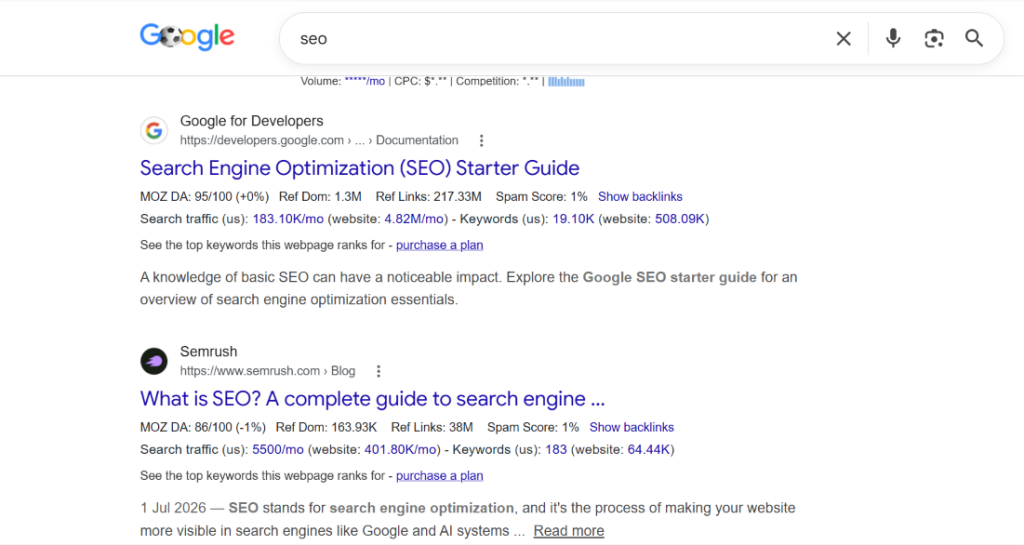
Traditional SEO focuses on improving rankings by optimizing technical performance, content quality, backlinks, user experience, and search intent. The ultimate goal is to increase qualified organic traffic from search engines.
SEO succeeds when users click your page after seeing it in search results.
What is Generative Engine Optimization (GEO)?
Generative Engine Optimization (GEO) focuses on making your content easy for AI systems to understand, trust, retrieve, and cite when generating answers.

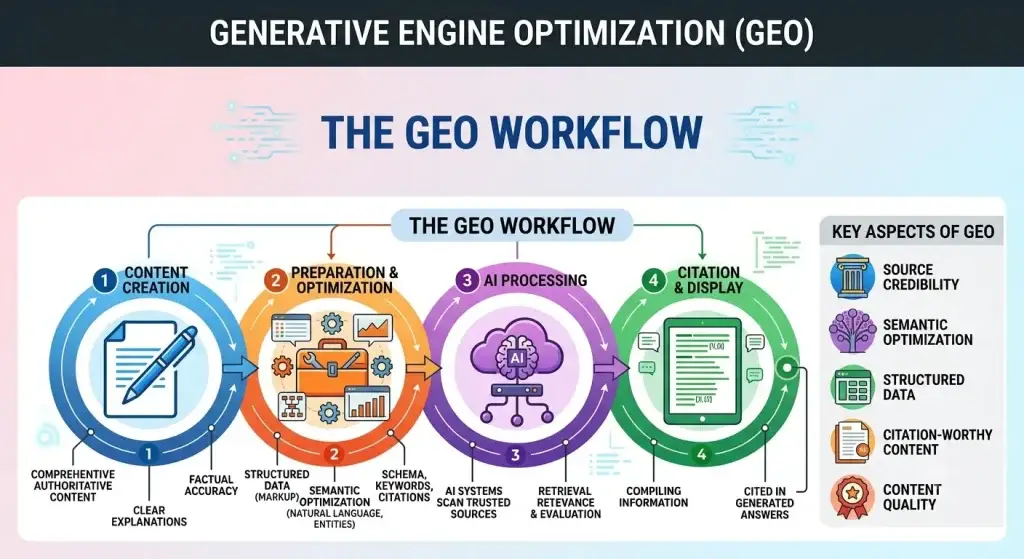
Instead of optimizing only for rankings, GEO optimizes for retrieval, factual accuracy, semantic relevance, structured knowledge, and citation potential inside AI assistants like ChatGPT, Gemini, Claude, Copilot, and Perplexity.
The goal shifts from earning clicks to earning citations and recommendations.
Summary
SEO improves rankings in search engines. GEO improves visibility inside AI-generated responses. Modern brands need both because search engines return links while generative engines synthesize trusted information into direct answers.
GEO vs SEO: How Search Engines and Generative Engines Work
Although they often answer the same question, Google Search and AI assistants retrieve information in very different ways.
Traditional search relies heavily on indexing entire pages and ranking them using hundreds of ranking signals. Large Language Models instead retrieve highly relevant passages, compare semantic meaning through embeddings, and synthesize information into one response.
SEO vs GEO Comparison
| Attribute | SEO | GEO |
| Primary Objective | Rank webpages | Earn AI citations |
| Primary Mechanism | Crawling + Indexing | Vector Retrieval + LLM Generation |
| Information Unit | Entire webpage | Individual passages |
| Signal Focus | Keywords, links, UX | Semantic relevance, authority, factual consistency |
| Measurement | Rankings, CTR, traffic | AI citations, Share of Voice, prompt visibility |
| Conversion Goal | Website visits | Brand inclusion in AI answers |
How Traditional Search Works
Search engines crawl billions of pages using bots. They organize content through inverted indexes and retrieve pages based on keyword relevance, authority, freshness, and hundreds of ranking signals.
Users then decide which result deserves their click.
How Generative AI Works
LLMs transform content into mathematical vector embeddings that represent meaning rather than exact keywords.
When someone asks a question, the AI retrieves semantically similar passages, evaluates credibility, combines multiple sources, and generates a natural-language answer.
Why Traditional SEO Alone Is No Longer Enough
SEO remains essential, but user behavior has changed dramatically.
Studies estimate that 68% of Google searches now end without a click, largely because users receive answers directly within search results through featured snippets, knowledge panels, and AI-generated summaries.
This means visibility no longer depends only on driving traffic.
Even ranking first on Google does not guarantee your content will appear inside ChatGPT, Gemini, Claude, or Perplexity.
Industry analysis indicates that the overlap between Google’s Top-10 organic rankings and AI-generated citations is only around 38%, showing that AI systems evaluate information differently.
AI engines prioritize:
- Clear factual statements
- Strong entity relationships
- Authoritative sources
- Verified statistics
- Consistent information across multiple websites
- Structured formatting
- Semantic clarity
Simply ranking well is no longer enough if AI cannot confidently extract your information.
How to Optimize for Google AI Overviews
AI Overviews summarize information from multiple trusted sources instead of displaying a single webpage. Brands improve visibility by publishing authoritative, structured, factual, and well-cited content that AI systems can confidently reference.
Best Practices
- Answer questions immediately
- Use concise definitions
- Add statistics with sources
- Structure information logically
- Include comparison tables
- Publish original insights
How to Optimize for Answer Engine Optimization (AEO)
Answer Engine Optimization (AEO) focuses on creating content that directly answers user questions in formats search engines and AI assistants can extract without additional interpretation.
AEO Checklist
- Use question-based headings
- Write direct answers first
- Add FAQ sections
- Keep definitions under 60 words
- Include lists and tables
- Support claims with evidence
The Technical Mechanics of GEO: How AI Selects Sources
Understanding how AI retrieves information makes GEO much easier to implement.
Modern LLMs rarely evaluate an entire article at once. Instead, they retrieve the most relevant sections before generating responses.
Passage-Level Retrieval
Generative engines split documents into smaller chunks or passages.
Each passage receives its own vector representation. AI compares the user’s query against millions of these embeddings and retrieves only the passages with the highest semantic similarity.
This explains why one well-written paragraph can become highly citable even if the entire page isn’t ranked first.
Embedding Similarity
Embeddings convert language into numerical vectors representing meaning.
Instead of matching exact keywords like “SEO agency,” AI understands relationships between concepts such as digital marketing, search optimization, ranking signals, content authority, and topical expertise.
Semantic similarity becomes more important than keyword repetition.
Atomic Claims
Atomic Claims are small, self-contained factual statements that can stand independently.
These statements reduce ambiguity and increase confidence during AI retrieval.
Examples include:
- Google uses hundreds of ranking signals.
- GEO improves AI citation visibility.
- Schema markup enhances machine readability.
- Vector search retrieves semantically similar content.
Each claim should be verifiable, specific, and supported by trustworthy evidence.
Verified quotes, authoritative statistics, and credible citations also improve confidence.
Research from Aggarwal et al. (KDD 2024) found that adding these credibility signals can improve AI visibility by up to 40%.
How to Build a Hybrid SEO + GEO Content Strategy
Winning today requires optimizing for both traditional search engines and AI systems simultaneously.
Think of SEO as the foundation and GEO as the amplification layer.
A successful GEO vs SEO strategy combines technical SEO, high-quality content, structured data, and AI-friendly formatting to maximize visibility across every search experience.
Step 1: Build the Technical SEO Foundation
Your website must first be technically excellent.
Focus on:
- Fast page speed
- Mobile optimization
- Crawlability
- XML sitemaps
- HTTPS
- Internal linking
- Canonical URLs
- Schema markup
- Entity consistency
Without this foundation, neither search engines nor AI systems can efficiently understand your content.
Step 2: Structure Content for LLM Parsing
AI prefers content that is predictable and easy to parse.
Create articles using:
- Question-based H2 headings
- Short definitions
- Bullet lists
- Tables
- Step-by-step instructions
- Expert quotes
- Original statistics
- Clear summaries
Avoid unnecessary filler between important ideas.
Example Structure
Question
Direct answer
Supporting explanation
Evidence
Summary
This pattern closely matches how LLM retrieval systems process information.
Step 3: Scale Digital PR and Entity Mentions
Authority now extends beyond backlinks.
AI systems evaluate how consistently your brand appears across reputable websites, industry publications, business directories, research papers, podcasts, interviews, and news articles.
Strong entity recognition increases trust.
Build authority through:
- Digital PR campaigns
- Expert interviews
- Guest articles
- Original research
- Industry reports
- Conference presentations
- Verified author profiles
- Consistent brand information
These mentions strengthen your Knowledge Graph presence.
GEO vs SEO: How to Measure Success
Traditional SEO metrics remain valuable, but GEO introduces entirely new performance indicators.
The two should be monitored together.
| SEO KPIs | GEO KPIs |
| Organic Rankings | AI Share of Voice |
| Organic Traffic | Brand Citations |
| Organic Clicks | Prompt Inclusion Rate |
| Impressions | Citation Frequency |
| Click-Through Rate | AI Recommendation Rate |
| Backlinks | Entity Mentions |
| Keyword Rankings | Branded Search Lift |
SEO Success Metrics
Track improvements in:
- Keyword rankings
- Organic impressions
- Organic traffic
- Click-through rate
- Page engagement
- Conversion rate
These metrics measure search engine performance.
GEO Success Metrics
Measure how often AI platforms mention your brand.
Monitor:
- AI citations
- ChatGPT visibility
- Gemini mentions
- Perplexity references
- Prompt success rate
- Share of Voice
- Growth in branded searches
These indicators reveal how visible your brand is inside AI-generated answers.
Frequently Asked Questions
Is GEO replacing traditional SEO?
When comparing GEO vs SEO, the answer is no. GEO complements SEO rather than replacing it. Search engines still drive significant traffic, while AI assistants increasingly influence how users discover information.
How do search engines and AI engines retrieve information differently?
Understanding GEO vs SEO starts with how information is retrieved. AI engines retrieve semantically relevant passages using vector embeddings, evaluate multiple trusted sources, and synthesize answers instead of displaying only a ranked list of webpages.
What makes content easily citable by AI assistants?
AI prefers content with direct definitions, short factual statements, original research, expert quotations, structured headings, comparison tables, schema markup, and trustworthy references. Content should answer questions clearly without requiring additional interpretation or context.
How do you measure brand visibility in ChatGPT and Gemini?
Measure AI Share of Voice, citation frequency, prompt inclusion, branded search growth, entity mentions, and referral traffic from AI platforms. Regular prompt testing across multiple generative engines helps identify how often your brand appears in AI-generated responses.
Should small businesses invest in GEO alongside SEO?
Yes. Small businesses can compete effectively by publishing authoritative local expertise, answering niche questions, and building strong entity recognition. GEO creates opportunities to earn AI citations even when competing against larger brands with stronger backlink profiles.
Conclusion & Strategic Next Steps
The debate around GEO vs SEO isn’t about choosing one strategy over the other. It’s about recognizing that modern search has evolved beyond ten blue links.
SEO continues to drive discoverability through traditional search engines, while GEO ensures your expertise is recognized and cited by AI systems that increasingly shape how people find information. Together, they create a stronger, more resilient digital presence.
Start by strengthening your technical SEO foundation, then structure your content for AI retrieval with clear definitions, factual “atomic claims,” tables, and question-based headings. Invest in entity building, digital PR, and authoritative citations to increase trust across both search engines and generative platforms.
Brands that combine Search Engine Optimization, Generative Engine Optimization, Answer Engine Optimization (AEO), and AI Overviews optimization today will be better positioned to earn rankings, citations, recommendations, and customer trust as search continues to evolve. The goal is no longer just to rank first—it’s to become the source that both people and AI choose to reference.
Mastering GEO vs SEO today means preparing your brand for both traditional search engines and the next generation of AI-powered search experiences.